
9,000 Visitors and only 160 Sign-Ups. Here’s What Simon Cowell’s Experience Can Teach You About Visibility & Conversion.

We’d all love more visibility. More people discovering our work. More traffic coming to our websites. More media coverage, social-media attention, followers, clicks, and curious people showing up to see what we do.
But attraction and visibility aren’t conversion.
You can create an enormous wave of attention and still have very little to show for it. When there’s no clear next step, no compelling reason to take it, or the attention comes from the wrong audience, thousands of visitors can disappear without buying, donating, registering, booking, or doing whatever you hoped they’d do.
What Simon Cowell and Boy Bands Can Teach You
I was watching Netflix this week, and it reminded me that content ideas and business lessons have a funny way of showing up when you’re not looking for them. Sometimes inspiration comes from research. Sometimes it comes from a client conversation. And sometimes it comes from sitting on the couch watching Simon Cowell try to build the next great boy band.
In the first episode of his new Netflix docuseries, Simon Cowell: The Next Act, Cowell gets a very public lesson in the difference between visibility and conversion.
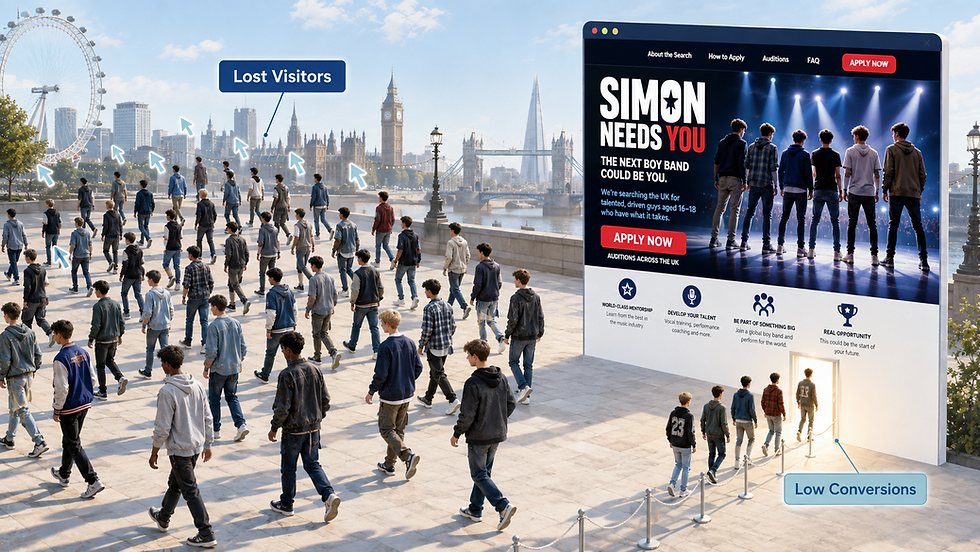
Cowell was launching a search for the next successful boy band. His “Simon Needs You” campaign included posters, press coverage, radio appearances, and the considerable visibility that comes with having Simon Cowell’s name attached to anything. The campaign appeared to work. Approximately 9,000 people visited the audition website.

Then came the number that actually mattered: only 160 people applied. That’s a conversion rate of less than 2%. Even more concerning, only 93 applicants were reportedly within the intended age range of 16 to 18. The campaign had created attention, but much of it hadn’t reached—or persuaded—the people Cowell actually needed.
Cowell called the results a disaster.
Curiosity Is Fragile—Don’t Make People Work to Take Action
When his team examined the problem, they discovered something almost painfully simple: the website made potential applicants work too hard. Visitors had to read several minutes of text before they even reached the application form.
For a highly motivated applicant, that might not seem unreasonable. But most website visitors don’t arrive highly motivated. They arrive curious.
And curiosity is fragile.
The campaign had done the difficult work of getting people to the door. The website then greeted them with a wall of unengaging information instead of making the opportunity immediately clear and the next step easy to take.
The team also had to confront a larger problem: they weren’t communicating through the channels or language that best matched their audience. Cowell placed considerable faith in radio and traditional publicity, approaches that had worked during the height of The X Factor. But now his target audience was teenagers, who don’t listen to radio or watch traditional TV.
Digital strategists pointed to the wordy website, changing media habits, and even the possibility that Cowell’s name didn’t carry the same recognition with Gen Z that it did with older audiences. The team eventually turned to TikTok creators and newer digital channels like podcasts, to reach prospective applicants more directly.
The lesson isn’t that traditional media doesn’t work or that teenagers never read. People will read, watch, research, and spend considerable time with something once they care enough.
But you can’t demand commitment before you’ve created desire. Visibility gets someone’s attention. Conversion requires a connected experience that carries that attention forward. The message that attracted someone must match what they find when they arrive. They need to quickly understand what’s being offered, why it matters to them, whether they belong, and what they should do next.
A visitor shouldn’t have to excavate your website like an archaeological site to find the button.
Lessons Learned: Make Your Visibility Convert
Start by deciding what action you actually want people to take. Don’t simply send them to a homepage and hope inspiration strikes. Make the next step obvious, specific, and easy. Reduce unnecessary reading, forms, clicks, and decisions—especially at the beginning.
Give people a compelling reason to continue. Show them what’s possible, how the opportunity relates to their lives, and why taking action now is worth the effort.
Most importantly, make sure you’re attracting the right audience. Ten thousand visits from people who’ll never act may be less valuable than 500 visits from people who genuinely need, want, or believe in what you offer.
Simon Cowell had publicity, name recognition, traffic, and attention. What he initially lacked was a clear path from “This looks interesting” to “I’m ready to apply.”
That’s the difference between being visible and being effective. Visibility fills the room. Visibility that converts moves the right people to do something once they’re there.
I help businesses and purpose-led organizations turn visibility into meaningful action—more leads, sales, sign-ups, donations, and engagement.

Comments